How to Position Your Coaching Offer for Conversions
by Julie | Jan 26, 2026
Position your coaching offer for conversions by clearly defining your ideal client, highlighting the specific transformation your coaching delivers, and aligning your messaging with the client’s goals, pain points, and buying triggers. Use structured offers, social proof, and clear calls to action to guide prospects from interest to enrollment.
Why Positioning Your Coaching Offer Feels Hard
Many online coaches struggle to convert prospects not because their coaching lacks value, but because the offer isn’t positioned in a way that resonates. This often happens when coaches focus on features, like “12 weekly sessions” or “email support”, rather than the outcomes their clients truly desire.
Prospects make decisions emotionally before rationally. If your messaging doesn’t connect to their desired transformation, they won’t see why your coaching is worth investing in. This disconnect leads to frustration: you may feel your offer is strong, but potential clients hesitate, compare alternatives, or drop off entirely.
Common Mistakes Coaches Make
1. Focusing on Features Instead of Transformation
Listing what your coaching includes is not enough. Clients care about results: the problem solved, skill gained, or life improved.
Example: Saying “Includes 6 modules and 3 live calls” is weaker than “Gain the confidence to land your first high-paying client in 90 days.”
2. Trying to Appeal to Everyone
Generic messaging like “I help people grow their business” rarely converts. Coaches need a well-defined niche and clear target audience.
Example: “I help solo female entrepreneurs build a six-figure launch plan” speaks directly to a specific audience with a concrete outcome.
3. Weak or Confusing Calls to Action
Even strong offers fail if prospects aren’t guided toward the next step. Calls to action like “Contact me if interested” are vague and non-committal.
Better approach: Use specific CTAs like “Book a free clarity call to see if this coaching fits your goals.”
4. Underestimating the Role of Social Proof
New clients want evidence that your coaching works. Failing to showcase testimonials, case studies, or measurable results lowers trust and conversions.
Strategic Framework for High-Converting Offer Positioning
To position your coaching offer effectively, follow the CLEAR framework:
1. Clarify Your Ideal Client
Identify demographics, pain points, goals, and objections. The more specific, the better.
Example: Instead of “business owners,” define “first-time coaches earning under $50k annually who want to scale to $100k within a year.”
2. Lead With Transformation
Highlight the outcome your coaching delivers, not the process. Focus on how the client’s life or business changes.
Example: “Go from overwhelmed and stuck to confidently attracting consistent clients in 90 days.”
3. Explain the Path
Briefly outline your coaching process in a digestible way. Break it into clear steps or modules, but always tie each step back to the transformation.
4. Add Evidence and Proof
Use testimonials, success stories, or data points to show credibility. This reduces hesitation and builds trust.
5. Request Action
End with a clear, low-friction next step. This could be scheduling a call, joining a free webinar, or downloading a resource. Make the path forward simple and compelling.
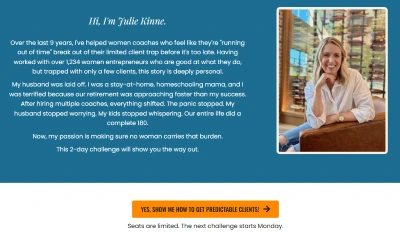
Example Positioning Statement
"Over the last 9 years, I've helped women coaches who feel like they're "running out of time" break out of their limited client trap before it's too late. Having worked with over 1,234 women entrepreneurs who are good at what they do, but trapped with only a few clients, this story is deeply personal..."
YES, Show me how to get predictable clients!
Frequently Asked Questions
How do I know if my coaching offer is positioned correctly?
Test messaging by tracking responses to your call-to-action. Strong positioning usually results in higher inquiries, more sign-ups, and positive client feedback.
Should I focus on my experience or client results?
Always prioritize client outcomes. Experience builds credibility, but prospects buy results and transformation.
How detailed should I get in describing my process?
Enough to build clarity, but not so much that it overwhelms. Focus on steps tied to results.
Can I target multiple niches with the same offer?
It’s better to focus on a single, well-defined audience. Broad messaging dilutes impact and lowers conversions.
How often should I update my positioning?
Review your positioning whenever client feedback, market demand, or results indicate messaging could be more compelling. Annual or bi-annual checks are common.
Get Your FREE Website ADA Audit Today!
Is your website truly accessible and ADA compliant? Don’t wait for a lawsuit to find out! Our FREE Homepage Audit shows exactly where your site may be failing accessibility standards and provides clear steps to fix it.
Get Your Full Website Accessibility Audit
Our full audit identifies accessibility issues, compliance gaps, and opportunities to make your site truly inclusive and eligible for the ADA business tax credit.
Upgrade to a Fully ADA-Compliant Platform
For long-term accessibility, move your site to the Lime ADACompliant Platform. Built to meet ADA & WCAG 2.2 AA standards, it simplifies compliance, lowers maintenance costs.